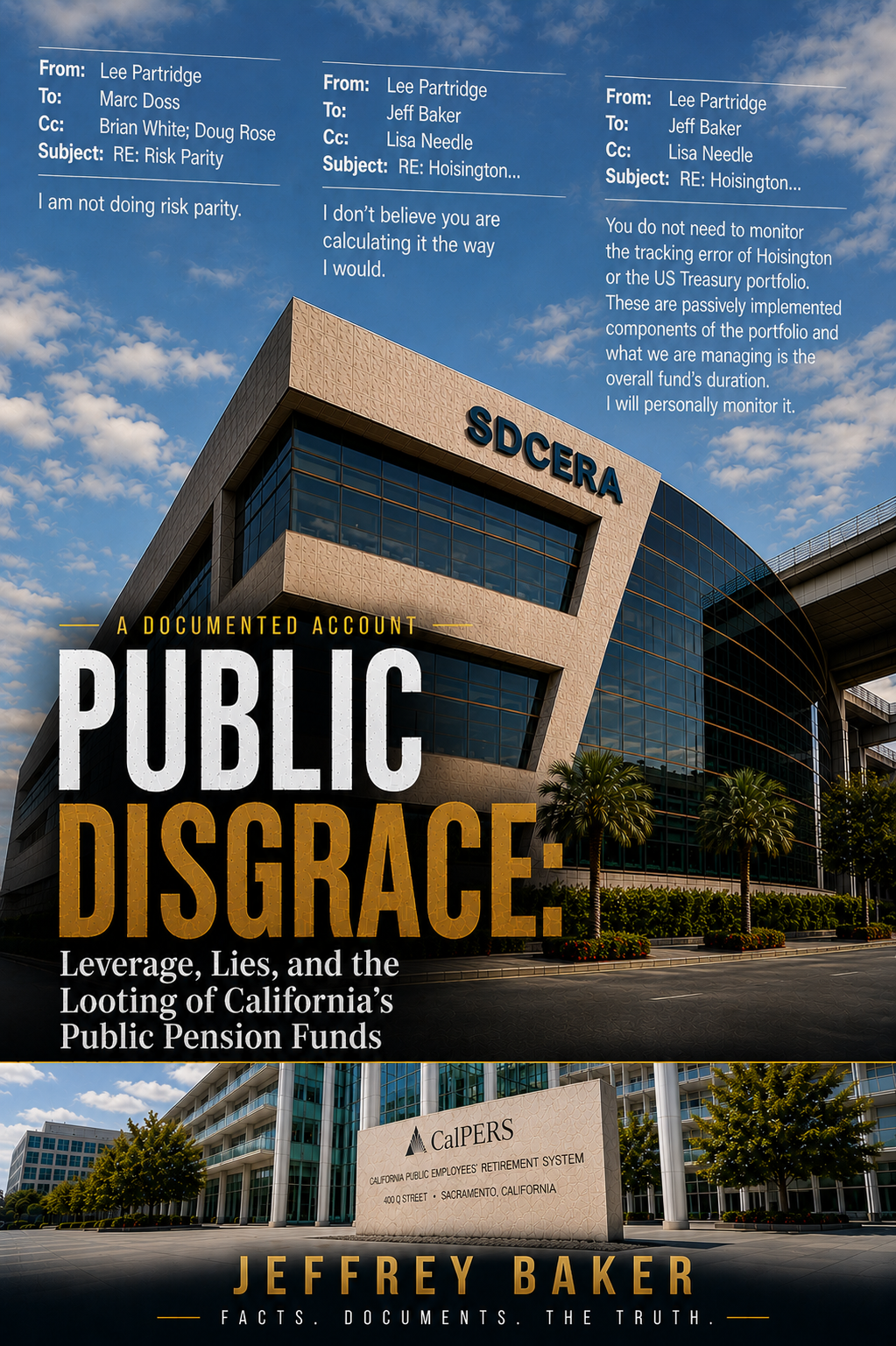
CalPERS building sign, 400 Q Street, Sacramento CalPERS · 400 Q Street · Sacramento, California
Public
Disgrace
Leverage, Lies, and the Looting of California's Public Pension Funds
Inside America's Public Pension System — and the Price of Telling the Truth
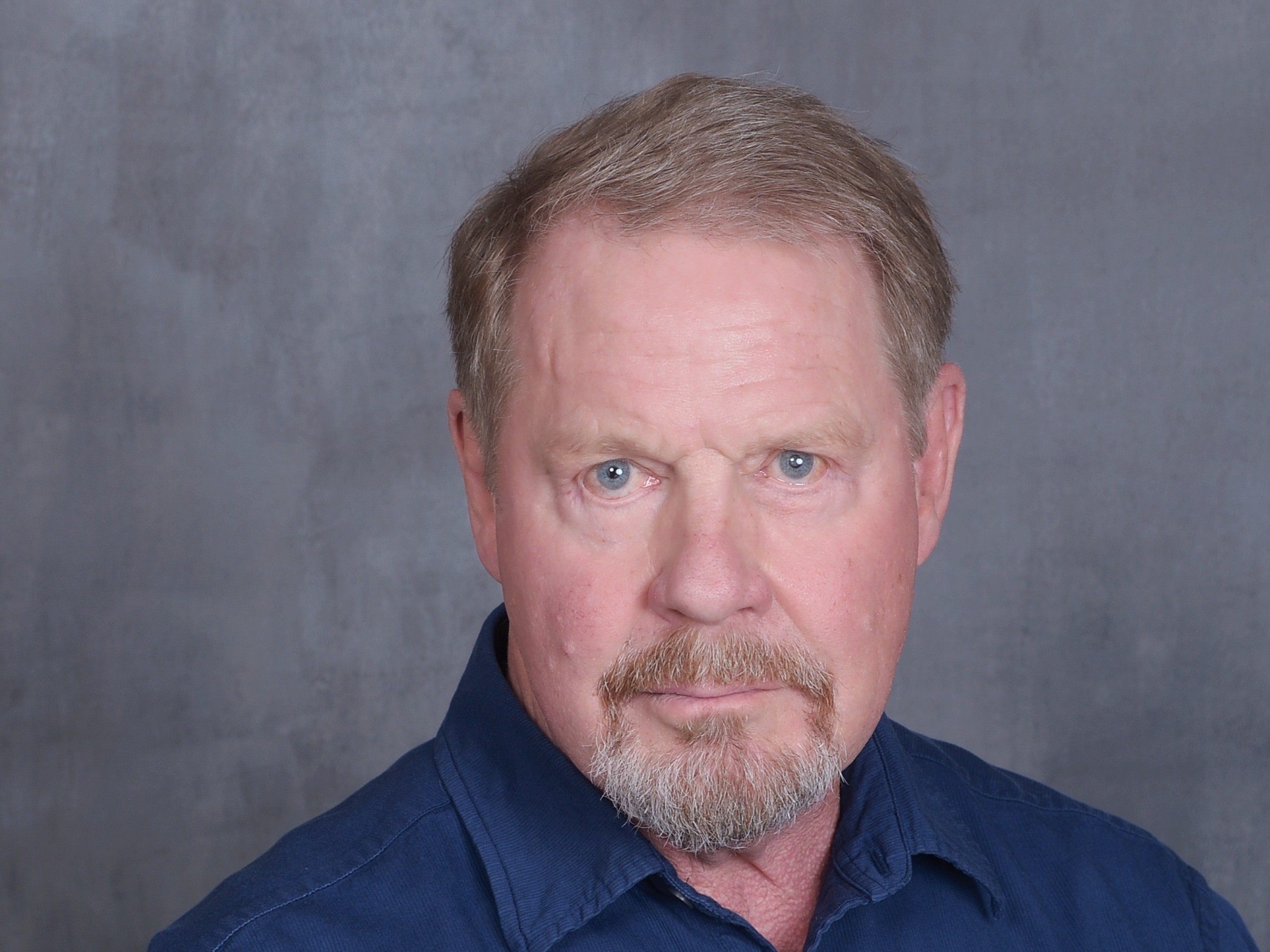
Jeffrey Baker
A Documented Account

Public Disgrace:
Leverage, Lies, and the Looting of California's Public Pension Funds Inside America's Public Pension System — and the Price of Telling the Truth

Jeffrey Baker spent a decade inside some of the largest public pension funds in the country — most significantly at CalPERS, where he learned what serious, professionally run pension governance looks like at the highest level.

When he arrived at San Diego County's $7 billion pension fund in 2007, he recognized immediately what proper management did not look like. By 2011 he had documented it. Then they called him wrong, incompetent, and delusional — and fired him.

This is the full story. It starts long before SDCERA.

4
Chapters on Origins
How Baker entered the investment business — retail, institutional, and the path to public pensions
17
Chapters on CalPERS
Inside one of the world's largest pension funds — what good governance looks like, and what happened when it was betrayed
41
Chapters on SDCERA
Documented fraud, retaliation, the civil service hearing, federal court, the CFA, and the Qui Tam
62
Total Chapters
The complete record — from first job to final court ruling, every claim backed by a document
"I had never seen anything like this in over thirty years of experience."
— Dan diBartolomeo, Northfield Information Services, on the SDCERA risk statistics
Jeffrey Baker
Jeffrey Baker
The Civil Service Commission said he was not a whistleblower. The judge questioned what his interest was. The defense called his claims "stale, old, and shopworn."

Then the board that fired him voted unanimously to fire the advisor he had warned them about. Four years later.

Jeffrey Baker

Jeff Baker's career spans all three sides of the investment management business — retail, institutional, and public pension funds. He spent seven years inside CalPERS — the California Public Employees' Retirement System, one of the most powerful investment institutions in the world — where he learned what serious, independent, professionally run pension governance looks like at the highest level.

He knew the standards. He knew the documentation requirements. He knew what independent monitoring, fiduciary compliance, and honest reporting to a board were supposed to look like. That knowledge is exactly what made him dangerous. And what he witnessed at CalPERS — the corruption under Buenrostro, the waste, the covered-up Oak payment — meant he recognized the pattern immediately when he arrived at SDCERA.

In December 2007 he joined San Diego County Employees Retirement Association as an Investment Officer. What he found — and what happened when he reported it — fills more than forty chapters of this book. But the book begins much earlier, with the story of how he got into this world in the first place, what he learned there, and why that background made him impossible to ignore and impossible for them to keep.

Baker was terminated in July 2011. The fund's outside advisor was fired four years later. The same board voted unanimously.

Former CalPERS SDCERA Investment Officer 2007–2011 Institutional Investment Career in Public Pensions

Three Sides of the Business.
One Long Paper Trail.

Jeffrey Baker worked across all three sides of institutional money management — retail, institutional, and public pension funds. He saw how the business was supposed to work. At CalPERS he also saw what happens when a CEO goes to prison, when a $12 million payment gets covered up, and when an institution protects itself instead of its members. At SDCERA he documented the same pattern at a smaller scale — and paid for it with his career. Every allegation in this book is backed by a document.

🏛️
The CalPERS CEO Went to Prison. The $12 Million Payment Didn't.

Federico Buenrostro was convicted and sentenced to eight years in federal prison for corruption. But the $12 million payment to Oak Associates — which Baker documents should never have been made — was never recovered. The institution covered it up rather than confront it.

Federal conviction · Payment records · CalPERS board documents
📊
At SDCERA, the Risk Limits Were Violated from Day One

The IPS set tracking error limits for the high yield program. The actual tracking error was over the limit from the beginning — but the board was shown a different figure, calculated using a formula that doesn't appear in the IPS anywhere. The US Treasury program didn't exist yet — it was created later and brought its own violations.

Board minutes · IPS · Tracking error analysis
🔄
The Board Approved One Investment. Another Was Funded.

The SDCERA board voted to invest in the Hoisington Duration Match product. Partridge funded the Hoisington Core-Plus product — the riskiest Hoisington product — without authorization. He admitted this under oath.

Board resolution · Sworn testimony
💰
A $723,000 Bonus Was Paid While the Fund Was Out of Compliance

At the March 2011 board meeting, Partridge received a performance bonus of $723,000. The board was told he had implemented the new Investment Policy Statement. He had not. The tracking error violations were active when the check was cut.

Board video · IPS · Bonus documentation
🎭
He Said "Yes" When the Answer Was No

At the May 2011 board meeting — one day after Baker filed his whistleblower complaint — trustee Loretta Morris asked directly: "Can we safely say we are completely in compliance?" He answered yes. One month later he confirmed the violations himself.

Board video May 2011 · Board video June 2011
⚖️
When Baker Reported It, Every Door Was Closed

Civil Service found him not a whistleblower. A federal court dismissed his case. A Qui Tam filed on behalf of 39,000 county employees was voted down unanimously — including by the trustee who encouraged Baker to file it. The institution investigated itself and found nothing wrong.

Civil Service findings · Court records · Qui Tam ruling

Every Claim Has a Document.

Supporting documents will be made available upon publication of the book.

📹
Board Meeting Records
View documents →
📋
Investment Policy Statements and Contracts
View documents →
📧
Emails
View documents →
⚖️
Court Filings & Rulings
View documents →
📊
Performance & Risk Reports
View documents →
📰
Internal Correspondence
View documents →
📰
Press Coverage
View documents →
📝
PRA Responses
View documents →

The new Investment Policy Statement went into effect on June 30, 2010. From that date forward, Lee Partridge — Portfolio Specialist at Integrity Capital Services, later CIO of Salient — was obligated to report any breaches of the IPS risk limits to the board at every Investment Board meeting.

There were nine consecutive Investment Board meetings between August 2010 and May 2011 during which active violations of the high yield and treasury risk limits were never reported by Lee Partridge, never appeared on the agenda, and were never discussed.

At the ninth meeting — May 19, 2011, one day after Baker filed his whistleblower complaint — trustee Loretta Morris asked directly: "Can we safely say we are completely in compliance?" Both Lee Partridge and Steve Voss of Hewitt Ennis Knupp answered yes.

One month later, at the tenth meeting listed below, Lee Partridge and consultant Steve Voss of Hewitt Ennis Knupp formally reported the breaches for the first time.

Every one of these meetings is on video. Review the agendas. Watch the presentations. Find a single mention of the high yield or treasury violations in meetings one through nine.

The Ten Investment Board Meetings — August 2010 through June 2011
Investment Board Meeting — August 19, 2010 Watch video →
Investment Board Meeting — September 16, 2010 Watch video →
Investment Board Meeting — October 21, 2010 Watch video →
Investment Board Meeting — November 18, 2010 Watch video →
Investment Board Meeting — December 16, 2010 Watch video →
Investment Board Meeting — February 17, 2011 Watch video →
Investment Board Meeting — March 17, 2011 Watch video →
Investment Board Meeting — April 21, 2011 Watch video →
Investment Board Meeting — May 19, 2011 ★ Loretta Morris asks: "Can we safely say we are completely in compliance?" Lee Partridge and Steve Voss of Hewitt Ennis Knupp both answer yes. Watch video →
Investment Board Meeting — June 16, 2011 ★ Lee Partridge and Steve Voss of Hewitt Ennis Knupp formally report the breaches for the first time. Watch video →

Public Disgrace
Updated as chapters are completed

Part One · Chapters 1–4
The Origins
How I entered the investment business and what I learned along the way — retail, institutional, and the path to public pensions
Part Two · Chapters 5–21
Inside CalPERS
The gold standard of pension governance — and what happened to it under Buenrostro, including the $12 million Oak payment that should never have been made
Part Three · Chapters 22–40
The Road to SDCERA
How I arrived at San Diego County's $7 billion pension fund — what I found, what I reported, and what they did about it
Part Four · Chapters 41–52
The Fight
Whistleblowing, retaliation, the civil service hearing, federal court, the CFA, and the Qui Tam filed on behalf of 39,000 county employees
Part Five · Chapters 53–62
The Aftermath
What they did after I left — and why the board that fired me voted unanimously to fire the advisor I warned them about four years later
"The board member who encouraged me to file voted with the rest of them to make sure no one ever answered for any of it."
— Jeffrey Baker, Chapter 62